

Scaling Google Ads for e-commerce should feel predictable.
In reality, for most brands, it feels like a gamble.
Revenue goes up.
ROAS goes down.
And suddenly, the same campaigns that worked last month start burning margin.
This isn’t bad luck.
It’s bad structure.
Most e-commerce Google Ads accounts are built to launch, not to scale.
They rely on:
This works at lower spend levels.
But the moment you push budgets, the cracks show.
One of the most common issues we see in scaling e-commerce accounts is self-competition.
Multiple campaigns bidding on:
Google ends up fighting itself, driving CPCs higher and confusing the learning system.
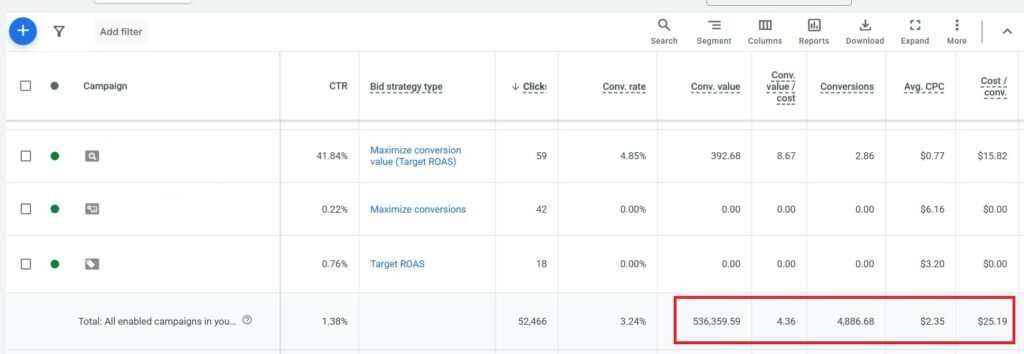
This is one of the first things we fixed in our $540K in 30 Days case study, where eliminating internal overlap unlocked immediate performance stability.
👉 Read the full case study here: $540K in 30 Days at 4.36x ROAS
Performance Max isn’t the problem.
Uncontrolled Performance Max is.
When PMax is launched without:
It expands aggressively — often into low-quality traffic that looks good in dashboards but destroys profitability.
In our case study, rebuilding PMax around product profitability and intent was a turning point for scale.
Here’s the uncomfortable truth:
Not all traffic deserves your budget.
Scaling e-commerce Google Ads is less about finding more customers and more about protecting margin while increasing volume.
That means:
This philosophy is core to our Google Ads for E-commerce framework.
👉 Learn how we structure accounts for profitable scale: Google Ads for E-commerce
When Google Ads is built correctly, scaling feels boring:
That’s not luck.
That’s discipline.
Most accounts don’t fail because Google Ads “stopped working.”
They fail because they were never designed to scale in the first place.
If your performance collapses the moment you increase budgets, that’s your signal to fix the system — not push harder.
👉 See how we scaled to $540K in under 30 days without breaking ROAS: Read the case study
 Contact Now